Four tenders open. Three close this week.
The measuring is not the hard part of your job; it is just the part that eats the week you needed for the thinking. What follows is one tender week with the measuring moved off your desk, and the name of the program doing each piece so you can check the claim on the page that describes it.
Monday to Friday
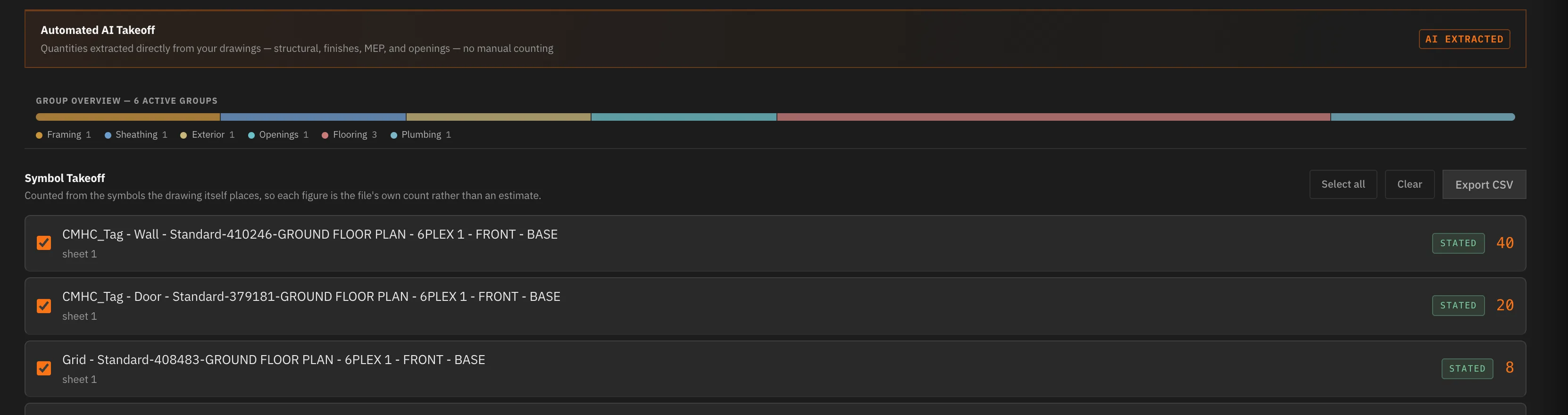
- Monday, before coffee: the set is measured. You upload the drawing set on Friday afternoon and it is counted by Monday: concrete, block, steel, finishes, off the sheets rather than off a scale rule. Blueprint Auditor reads the DWG if you have it and the PDF if you do not, and it tells you which sheets it could not read confidently instead of quietly averaging them into a total.
- Tuesday: the manual disagrees with the drawings. It usually does. SpecChecker reads the project manual against the sheets and reports where the two contract documents contradict each other, quoting both. The useful ones are the material orders you should hold: a door schedule showing an unrated leaf where Section 08 11 00 requires ninety minutes is not a rounding error, it is a replacement with a lead time measured in months.
- Wednesday: the quantities become a price. The takeoff lands in AI Estimator without anyone retyping a figure. Assemblies resolve against a dated rate table for your market, the contingency comes from risk rules with a written reason beside each one rather than a number picked by feel, and permits and development charges are priced under the jurisdiction you are actually building in.
- Thursday: the sub quotes are not comparable, and now you can see why. One excluded the controls. One priced a different sequence. One never acknowledged Addendum 4. Bid Leveler normalises them onto one scope and prices the gaps from what the other bidders carried, so the lowest number and the lowest cost stop being the same assumption. Every adjustment prints the basis it was made on, because the first invented adjustment you take to a subcontractor is the last time anyone opens the app.
- Friday, and the addendum lands: re-run the affected part, not the week. An addendum two days before close changes three sections and adds one. Because there is one project database across the programs, you re-run the stages the revision touches and carry their output forward, rather than starting the sequence again. That is the difference between an evening and a re-bid.
What it will not do for you
It does not decide anything. Every quantity traces to a drawn element, every adjustment to a line in a quote, every contingency to a rule you can read. The model writes the narrative around those numbers and gets no vote on what they are — turn it off and you lose the prose, not a single figure.
It will not read a badly scanned sheet as well as you will. At low resolution, recognition misreads exactly the characters that matter — 5/8 as 5/B, 90 as 9O. Those are surfaced as low-confidence and marked for you to verify, which is the honest behaviour and also the annoying one.
And it does not replace the judgement that makes you worth paying. It gives you back the three days of clicking that were standing between you and the judgement.
“Our chief estimator used to do hand takeoffs for three days. Now she reviews a structured first pass in half a day and spends the saved time actually thinking about strategy. We’ve cut bid-to-submit time roughly in half on commercial work.”
Director of preconstructionICI/commercial GC · Greater Toronto Area · name withheld at the customer’s request
Questions estimators ask.
Which plan do I need for takeoff and estimating?
Field, $149 a month: Blueprint Auditor measures the set and the AI Estimator prices it, with nothing retyped between them. Solo ($69) is the estimator on its own, for a quantity list you already have. SpecChecker opens on Crew ($299), Bid Leveler on Pro ($499). See the five plans.
What happens with a badly scanned sheet?
It is read at lower confidence and marked for you to verify, not folded into a total. At low resolution recognition misreads exactly the characters that matter — 5/8 as 5/B, 90 as 9O — so those sheets are named rather than averaged.
Does it price in my own market?
Rates, tax, permits and development charges load from the jurisdiction data pack for where you are building, and each rate carries its source and date. Toronto is the deepest pack; the regions page says which markets are thinner.
Is there a free trial?
Field is free for fourteen days — Blueprint Auditor and the AI Estimator on your own drawings, a card at Stripe to start and nothing charged until day 15. Solo has a seven-day trial of the AI Estimator on its own. One trial runs per account; Crew, Pro and Firm have none.
Test it on the ugly set.
Not the tidy job from the good consultant — that proves nothing. Use the one with four revisions, a late addendum half the trades never read, and thirty pages that came back from the printer as flat scans. Fourteen free days on Field, and if it has not earned its place before day 15 you cancel from your own dashboard and keep whatever it found.
- 14 days free on FieldNothing charged until the trial ends.
- Cancel from your dashboardNo contract, notice period or fee.
- Your work exportsPDF, Excel and CSV — kept 90 days after you leave.
- A setup call on a real job60 minutes on Pro and Firm, 30 on Field.
Not the seat you sit in? These are the others: