Drawing sets
● ReadDWG · PDF · DXF
Blueprint Auditor reads DWG drawings, vector and scanned PDFs and DXF exports — sheets, layers, dimensions and title-block data.
Every program writes files in the format the system on the other side actually imports — a Procore budget CSV, a Sage job-cost budget, a Bluebeam quantity summary, an Excel matrix. That has always worked with nothing to install and nothing to authorise, and it still does.
On top of that, a small number of services can now be connected, so a drawing set can come straight out of the place it already lives and a finished audit can announce itself to the channel your team already watches. Connecting is opt-in, per account, and nothing is read until you do it. The table below says which is which, because the difference matters.
 Excel
Excel

 Slack
Slack Microsoft Teams
 OneDrive
 SharePoint
 Google Drive

A file format — nothing to set up
Everything under “Exports” and “What you can upload” below. No account to link, no permission to grant, no admin involved. This is most of this page, it works on every plan, and it is unchanged.
A connection — you authorise it, once
A short list, marked Connected below. You sign in to the other service and grant access; we hold a credential on your behalf until you disconnect, which revokes it immediately. Nothing is connected by default.
Nothing you did not ask for
Procore, Autodesk, Sage and Bluebeam remain formats only — there is no app to install in your tenant and no admin granting a third party access to the project. The connections that do exist are the ones listed below, and each is off until somebody on your account turns it on.
You see every file
Each export lands in your downloads as a file you can open, read and correct before anything reaches your PM platform. Nothing we produce appears in your systems until you import it deliberately.
Works the same on every plan
Formats are not a tier. Every plan writes the same exports for the programs it opens. There is no connector licence and no per-integration fee.
The trade-off on the file side is stated plainly: a file handoff means somebody clicks import. What it buys you is that a tender package under NDA never gets handed to a connector, and that a bad number is caught in a spreadsheet before it has written itself into your budget. Every export below still works this way whether or not you connect anything.
Scanned pages and photographed drawings go through OCR, so a set that came back from the printer as a flat image is still readable. Everything below is a format the programs parse today.
DWG · PDF · DXF
Blueprint Auditor reads DWG drawings, vector and scanned PDFs and DXF exports — sheets, layers, dimensions and title-block data.
PNG · JPG · TIFF · BMP · WebP · HEIC
Photographed spec pages and scanned addenda are OCR'd before they are read. A phone photo of a marked-up sheet counts as a document.
DOCX · DOC · RTF · PDF · TXT · MD
SpecChecker and ScopeGuard read the project manual in whatever the consultant issued it as, including the Word file nobody bothered to PDF.
PDF · DOCX · XLSX · CSV · EML
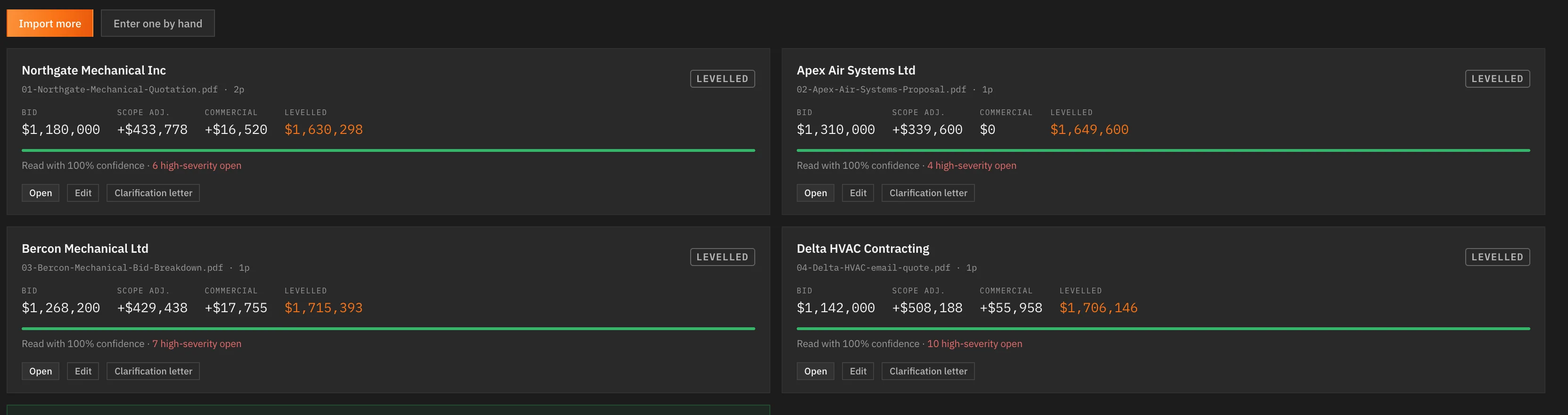
Bid Leveler takes quotes as they arrive — a letterhead PDF, somebody's spreadsheet, or the raw email with the price in the body.
XLSX · XLSM · XLS · CSV
Existing takeoffs, door and window schedules, and your own rate sheets. AI Estimator will price a quantity list you already have.
R13 · R14 · 2000
Every DWG AutoCAD has written since 2004 reads directly. A drawing saved as R13, R14 or 2000 is refused by name, with the one instruction that fixes it: save it as a 2004-or-later DWG, or export DXF. It says which, instead of half-reading it.
Each row is a real export in the program named, written with the columns the target system's importer expects. Where a format is our own shape and no vendor's published one, it says so.
| Where it goes | From | What the file is |
|---|---|---|
| Procore | AI Estimator Bid Leveler ScopeGuard |
Budget import CSV — cost code, description and amount split by cost type. Bid tab CSV. Issue/punch import CSV using the column names Procore's importer expects. File import, not a connector. |
| Sage 300 CRE Sage 100 Contractor |
AI Estimator | Job cost budget CSV with labour / material / equipment / subcontract categories and budget hours, ready for the job cost import. |
| QuickBooks Desktop & Online |
AI Estimator | Estimate line CSV at sell price with taxable lines marked, so the client-facing number does not get retyped into accounting. |
| Bluebeam Revu | AI Estimator ScopeGuard |
Quantity summary CSV carrying the takeoff source reference, so each line can be checked back to the sheet it came from. Markup summary CSV with subject / comment / status columns. |
| Excel, Sheets or any project log |
The five pre-award programs | Blueprint Auditor's Excel report. Bid Leveler's levelling matrix, bid comparison and findings register. SpecChecker's conflict matrix. ScopeGuard's buyout register. AI Estimator's CSI division roll-up and buyout list sorted by lead time. |
| Email, Word or a PDF reader |
The five pre-award programs | Drafted RFIs as text, one per finding, ready to paste. Clarification letters. The scope paragraphs to attach to each subcontract. Client proposal and award recommendation as PDF. Audit summary as Markdown for a wiki or a weekly report. |
| Your own tooling | SpecChecker ScopeGuard Bid Leveler |
Full project data as JSON — every finding with its source references intact — plus a flattened findings payload if you are posting into an internal endpoint of your own. Our shape, documented in the file. |
The handoffs that matter most are not to a third party at all — they are between the programs your plan already opens. A Pro or Firm plan runs the whole chain without anything being retyped.
01
Measured quantities move across in the estimator's own import format, so a takeoff becomes a priced bid without a second measurement.
02
The levelled subcontractor number goes back into the estimate as that trade's cost, carrying the adjustments that produced it.
03
Open findings from levelling arrive as the scope questions to settle during buyout, instead of being lost between the two meetings.
AI Estimator is on every plan and Blueprint Auditor from Field up; SpecChecker and ScopeGuard open from Crew, and Bid Leveler on Pro and Firm. See what each plan opens →
The whole list, including what is not built yet. Connect and disconnect from your dashboard; disconnecting revokes our access on the spot, and closing your account revokes it too.
| Service | What it does | Scope | Status |
|---|---|---|---|
| Slack | Posts to a channel when an audit finishes, a spec conflict blocks a material order, a sub’s insurance lapses or a job is forecast over budget. Outbound only. | Everyone on the plan | Live |
| Microsoft Teams | The same notifications, as an Adaptive Card in the channel you choose. Outbound only. | Everyone on the plan | Live |
| OneDrive & SharePoint | Pick a drawing set straight out of the library it already lives in, instead of downloading it to a laptop to upload it again. Reads only the files your own account can already open. | Per person | Days away |
| Google Drive | The same, for firms on Google Workspace. Will use Google’s own file picker, so it can only ever see the files you hand it. | Per person | Next |
| QuickBooks Online | Push a pay application or a cost budget into your books instead of re-keying it. Writes only what you send, and never the same thing twice. | Everyone on the plan | In review with Intuit |
| Procore | Drawing register, RFIs, submittals and budget, as a connection instead of a CSV. The CSV exports below keep working either way. | Everyone on the plan | Planned |
“Per person” means a teammate cannot see the drive you connected, because it is your own filing cabinet. “Everyone on the plan” means the opposite and is deliberate: a firm has one accounting system and one site channel, so seats do not multiply them.
No live two-way sync
Nothing we produce lands in Procore, Autodesk Build or ACC by itself. Somebody imports the file. If a vendor tells you their AI writes back automatically, ask what happens when it is wrong. Where write-back does arrive — QuickBooks first — it will be something you trigger, and it will refuse to post the same invoice twice.
No plugins
There is no Revit add-in, no Bluebeam plugin and no Procore marketplace app. Nothing installs into software you already run.
No mailbox, Slack or Teams ingest
We can post a notification to a channel you connect. We do not read one, and we never read your project mailbox — the permission we ask for cannot. You can upload an .eml file to Bid Leveler; that is the extent of what comes in.
No public API
There is no endpoint to call us on and no webhook to subscribe to. The JSON exports exist so you can feed your own tools from a file instead.
This list shrinks as things ship, and the table above is the record of it: everything marked Live is usable today, and nothing appears there before it is. A row that says Next or Planned is not a commitment to a date.
If your accounting package or project log imports a shape we do not write yet, send us a sample of the file it expects. Adding an export format is small work and it ships to everyone on the plan, at no extra cost. A genuine live connector into your own systems is different work — that is a custom build, quoted separately.
Send Us a Sample File →Fourteen free days, unlimited. Upload a drawing set or a folder of sub quotes, export the file your system needs, and open it in Excel before you decide anything. That answers the integration question better than any matrix.