Skip to content
Regions & rate packs

Every jurisdiction is a data pack.

Every rate, tax percentage, statutory holdback, permit fee and code citation lives in a JSON data pack — a plain text file you can open. Every figure prints the authority it came from, so you can check it instead of trusting it.

That means changing jurisdiction is a data edit, not a rebuild. Packs are built for any Canadian province or territory, any US state, and any EU country plus the UK and Ireland — sourced and cited to that jurisdiction’s own authorities, and every plan reaches every pack including Field. Jurisdiction is not an upgrade.

Code packs shipping today
Jurisdiction Rules Depth
Ontario105baseline
British Columbia7baseline
California5baseline
Florida16baseline
New York City16baseline
United States — IRC baseline12baseline
Canada — NBC baseline9baseline
England4baseline

baseline — the model-code requirements that jurisdiction adopts unchanged are checked; its own local amendments are not applied yet. The audit tells you which depth you are reading before it shows you a single finding.

Every pack is currently baseline, including Ontario. The tier above it — verified, meaning every rule checked against the authority by somebody other than whoever wrote it — needs a second person, and this codebase has had one committer throughout its history. Ontario, British Columbia and California were marked verified until 29 August 2026, when we could not evidence that second check and demoted them. A pack goes back to verified when there is a name and a date on the check, and only then.

Rate, tax and cost data runs wider than the code rules do — 43 cities across Canada, the United States and Europe, 19 of them European. England ships a code pack today (Approved Document K); an EU-country code pack is authored on request, and we would rather say so here than let you discover it.

one stair, five codes

The same check gives a different answer in every market.

This is what a jurisdiction pack is for. Draw one private stair and run it under five different packs: the geometry does not change, the verdict does. Every figure and citation below is read out of the shipped rule files.

JurisdictionMax riser Min going / treadMin clear width
Ontario
OBC 2025, Art. 9.8.4.1
200 mm235 mm860 mm
Canada — NBC baseline
NBC 2020, Div. B 9.8.4.1 / 9.8.2.1
200 mm—860 mm
United States — IRC baseline
IRC 2021, R311.7
196 mm (7¾″) 254 mm (10″) 914 mm (36″)
California
CRC 2022, R311.7.5
196 mm (7¾″) 254 mm (10″) 914 mm (36″)
England
Approved Document K (2013), Table 1.1
220 mm220 mm—

A stair that passes in London fails in Toronto by 20 mm a riser, and one that passes in Toronto fails in Sacramento by 4. Point the audit at a jurisdiction and it reports under that jurisdiction’s article numbers, so the finding is something you can hand to a plan examiner, instead of a note saying the stair looks steep.
Florida · no Ontario analogue

Glazed openings in a wind-borne debris region must be impact-rated or shuttered (FBC Residential R301.2.1.2), Miami-Dade and Broward are the High-Velocity Hurricane Zone with their own approval regime, and the ultimate design wind speed and exposure category have to be stated on the drawings.

New York City · what the pack refuses to guess

Work requires a DOB filing by a registered design professional (NYC Admin. Code Title 28). The pack also carries a rule whose only job is to say that the City’s own amendments are not applied yet, so the audit tells you that before it shows you a finding, so a clean run never reads as approval.

How the knowledge is separated

The engine is jurisdiction-neutral. The local knowledge is a named layer on top.

This isn't a claim about intent — it's how the files are laid out. ScopeGuard's scope knowledge base is indexed by CSI MasterFormat, the same taxonomy used across North America. Jurisdiction-specific content sits in separately named fields that can be replaced without touching the requirement itself, which is exactly how one pack becomes the next.

215

Scope requirements

Across 20 trades. Every one carries a CSI MasterFormat code — 21 divisions, from 01 General Requirements to 33 Utilities.

59

Ontario-specific references

The local_ref fields — O.Reg. 213/91, Toronto Ch. 591, excess soil rules. About a quarter of the base. Swappable line by line.

~73%

Portable as-is

Hoisting responsibility, submittal cycles, cut-and-cap, as-builts — these are disputed on every job in every country. They move with you unchanged.

one requirement, as it ships
{
  "code": "01-020",
  "title": "Hoisting, cranage and material handling for own work",
  "csi": "01 54 00",           portable — CSI MasterFormat
  "criticality": "high",
  "unit": "LS",
  "note": "The single most disputed item on GTA mid-rise…"  edit per market
}

The requirement, its keywords, its criticality and its unit basis are jurisdiction-neutral. Only the note is local, and it's a string in a file you own. Retarget it to Vancouver, Chicago or Milan by editing one line.

Anatomy of a jurisdiction pack

What actually changes between markets

Every pack carries the same sections, so the engine reads them identically wherever you point it, and every statutory number inside carries its citation, printed beside it in the output, so an estimator can verify it before relying on it. Here's the full shape of the file, with Toronto shown as the worked example.

Pack section Toronto / Ontario, as an example The same field elsewhere
taxHST 13% (5% federal / 8% provincial), new housing rebate capped at $24,000GST+PST, state & local sales tax, or EU VAT with reverse-charge handling
labour_burdenCPP 5.95%, EI 3.22%, EHT 1.95%, WSIB rate group, vacation payFICA/FUTA/SUTA and workers' comp, or the national contributi previdenziali
construction_act10% statutory holdback, prompt-payment clock, lien preservation & perfection days, adjudicationState retainage & mechanics-lien deadlines, or the local retention regime
permits_feesBuilding permit per m², minimum fee, examination rate, construction surchargeThe municipal fee schedule wherever you build — same shape, different numbers
codeOBC reference, accessibility, energy, frost depth 1.2 m, seismicIBC + local amendments, NBC, or Eurocodes with the national annex
winterDec–Mar, heating degree days, productivity loss %, temporary heat costZero in a mild climate; larger in Winnipeg or Helsinki. Same three fields.
bonding_insurancePerformance & L&M bond %, premium, public-work threshold, CGL minimumsMiller Act thresholds in the US, or the local surety and guarantee practice
green / by-lawsToronto Green Standard v4, green roof by-law, noise Ch. 591 permitted hoursDrop the section, or replace with the local sustainability and nuisance rules
escalation_outlookAnnual material & labour %, trades under pressureYour own market read — this one you'll want to retune yearly regardless

Price catalogues are separate again

95 material items and 24 crew compositions sit in their own files, with a city cost index applied on top — material, labour, equipment and subcontract factored independently, because a remote job has near-baseline material cost and a large labour premium.

On top of that sits a user-override layer and an optional supplier feed. Your real buyout numbers beat our defaults without anyone editing the baseline.

Everything prints its source

Each statutory number carries a citation string that appears next to it in the estimate and the proposal PDF. The pack is marked verify_before_bid for a reason — these are costing inputs, and none of it is legal advice.

When you retune a pack, the citation travels with the number. Whoever reviews the bid can check it against the current source.

Where each market actually stands

Same structure everywhere. Different depth.

The mechanism is real and in production, and it runs in any Canadian province, US state or European country, but the packs are not all equally deep, and it would be misleading to present them as though they were. Toronto is the finished reference implementation, and it is the standard your jurisdiction’s pack is built to. Here is what that means for everywhere else.

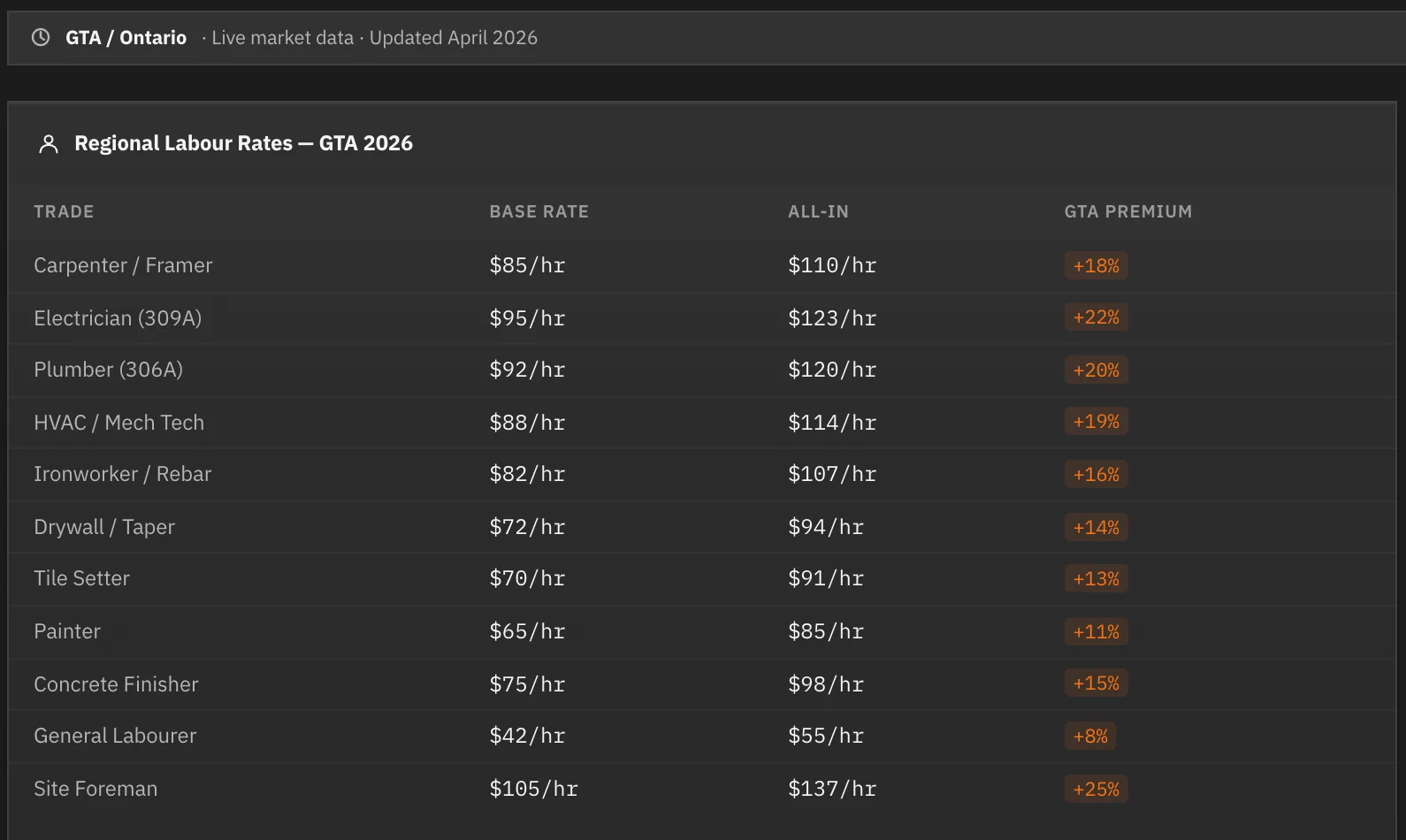
Reference depth, in practice — the Toronto rate set an audit run here is priced against
Reference depth

Toronto & GTA

The deep pack. HST and the new housing rebate, Construction Act holdback and prompt-payment timelines, Toronto building permit and examination fees, development charges, parkland dedication and community benefits charge, Toronto Green Standard v4, the green roof by-law, Ch. 591 noise hours, ravine and heritage constraints, excess soil under O.Reg. 406/19, fair wage policy, Tarion warranty, frost depth and winter productivity.

Plus a 24-city Ontario cost index with Toronto as the 1.000 baseline. This is what a jurisdiction pack looks like when it's finished.

Built for your job

Other provinces

British Columbia already has its own code rule set, alongside Ontario and California, so an audit run there cites BCBC instead of the OBC. Alberta, Québec and the rest share the structure exactly — different holdback rules, lien periods, sales tax treatment and code references, same fields, and a region with no rule set of its own says so on the report instead of quoting the wrong code at you. The National Building Code lineage means much of the code section carries across with the provincial amendments layered on top.

Québec is the one that diverges most: CCQ labour rules and French-language documents both have real consequences for the pack, and it is the province whose local-practice notes we most want feedback on.

Built for your job

United States

The closest fit of the three, because the scope taxonomy is already CSI MasterFormat — the divisions and section numbers a US estimator already reads, unchanged. What differs is statutory, and it differs per state: retainage and mechanics-lien deadlines, IBC with local amendments, FICA/FUTA/SUTA and workers' comp in place of CPP/EI/WSIB, sales tax in place of HST, Miller Act thresholds for public work.

Imperial units are native already — the catalogue runs SF, LF and CY alongside metric.

Built for your job

Italy & the EU

We have a Rome office and work in the Italian market, so this isn't theoretical for us. The Italian pack carries VAT with reverse charge, the prezzario regionale as the price baseline, SOA qualification categories, CCNL Edilizia labour costs, Eurocodes with the national annex, and the ritenuta a garanzia in place of statutory holdback.

Elsewhere in the EU the same pattern holds: national VAT, a local price book, Eurocodes plus annex. Documents in the working language are a model configuration question.

Being precise about the claim

Breadth of coverage is not the same as equal depth, and we'd rather you heard that from us than found it out. Every jurisdiction has a pack with the same field structure, so the engine behaves identically wherever you point it. What varies is how much local detail sits inside — Toronto carries green-standard, noise by-law, ravine and heritage content that has no equivalent in a pack for a market with no such rules, and there are markets where the statutory sections are complete but the local-practice notes are thinner than Toronto's.

Two things stay true everywhere: every statutory number carries the citation it came from, so it can be checked against the current source before a bid goes out; and after handover you can edit any of it yourself. That's what having the source means. Tell us your jurisdiction on the call and we'll walk you through its pack, section by section, against the finished Toronto one, so you can see the depth you're getting before you commit to anything.

GCs working across provinces

Run more than one pack. The engine picks up whichever the project points at, so an Ontario job and an Alberta job price under their own rules in the same install.

Anyone outside the GTA

The Toronto depth is the demonstration, not the constraint. Load your own rate book during the free trial and see what it looks like in place before you pay for anything.

Estimators who don't trust defaults

Good. Neither do we — the override layer exists so your real buyout numbers beat our baseline without anyone touching the catalogue.

Canada, the US and the EU/UK

Tell us where you build.

Bring a rate book, a recent bid, or just the jurisdiction, and we will say what your pack would need and how much of it already exists — before you commit to anything. Toronto is the deepest pack, and you own every file.