The GC says it’s yours. What does the file say?
A back-charge arrives for finishes the architect added at week eleven. You know it is not your scope. Proving it means finding a transmittal, a delivery ticket and a superintendent’s note that are somewhere in eight months of email. Most subs eat it because the argument costs more than the charge.
The reason that argument is expensive is not that you are wrong. It is that the record was never assembled while it was cheap to assemble — it was assembled afterwards, under time pressure, by whoever could be spared.
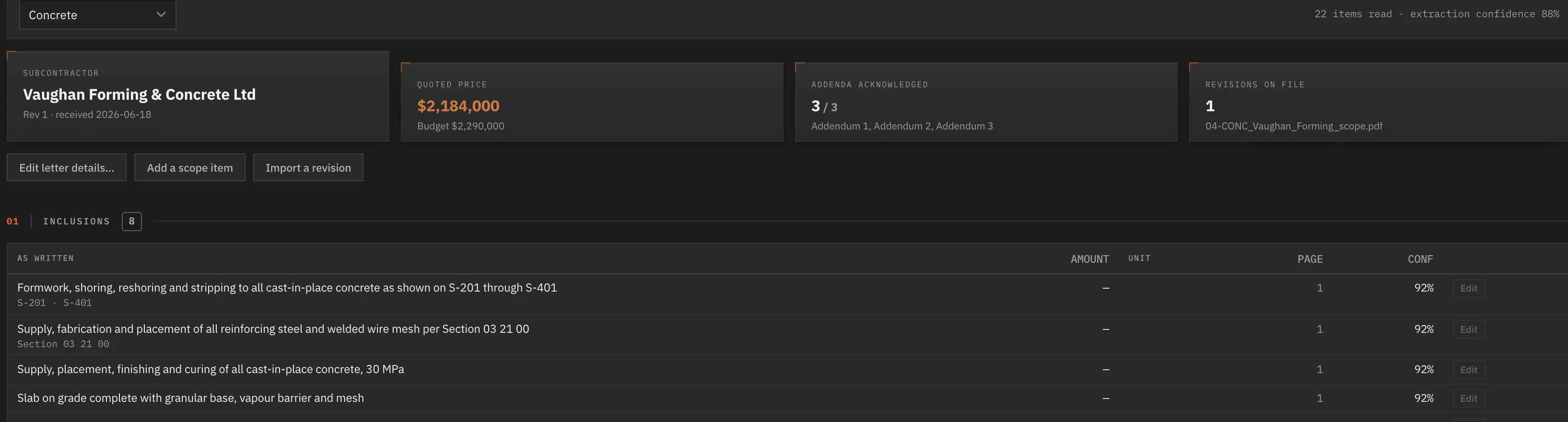
So the useful move happens at buyout, not at the back-charge. ScopeGuard reads your own proposal against the GC’s tender package and reports where the two disagree about what you are carrying: work you excluded that the package requires, work two trades are both pricing, and wording of yours that will not survive somebody reading it uncharitably in eight months. You find out what you have actually signed up for while you can still write a clarification letter about it.
Silence is the expensive part. An exclusion is on the record and can be argued. The item nobody mentioned at all is the one that reaches site unresolved, and it is the one that becomes a back-charge.
After award, the same principle applies to the paper. The daily logs, transmittals, correspondence and deficiency lists inside Blueprint Auditor are not there to be admired; they are there so that when a charge lands, the file already exists and is already cited to a date, a document and a page. The conversation stops being your memory against theirs.
None of that requires you to change how you work. You are already producing the logs and the transmittals. The difference is whether they are searchable, dated and attached to the scope they belong to, or in a folder somebody has to go through.
What it will not do: it will not win an argument you are actually losing, and it will not read a photograph of a delivery ticket as reliably as it reads a PDF of one. Low-confidence readings are flagged for you to check rather than quietly folded into a total, which is the honest behaviour and occasionally the irritating one.
“We used to lose 60–70% of back-charge fights because the documentation just wasn’t there. Now the file is built as we go. We’ve successfully pushed back on three back-charges this quarter that we would have eaten last year.”
Owner / project managermid-size mechanical contractor · Greater Toronto Area · name withheld at the customer’s request
One firm, one quarter. Whether it holds on your jobs is a question the free trial answers on your own documents, which is a better test than this quote.
Questions subcontractors ask.
Which plan opens ScopeGuard?
Crew and up: $299 a month for up to three people, with Blueprint Auditor, the AI Estimator and SpecChecker. The daily logs, transmittals and deficiency lists live in Blueprint Auditor, which Field opens at $149.
Can it read a photo of a delivery ticket?
Yes, through OCR, but less reliably than a PDF of the same ticket. Low-confidence readings are flagged for you to check rather than folded into a total.
Is the free trial enough to test a back-charge?
Field’s fourteen days cover Blueprint Auditor and the AI Estimator, which is where the logs and correspondence live. ScopeGuard, which reads your proposal against the GC’s package, opens on Crew and has no trial. One trial runs per account.
Bring an open back-charge.
One you are currently arguing about, with your proposal and whatever record you have. Fourteen free days is enough to find out whether the file supports you, and if it does not, that is worth knowing before the meeting too.
- 14 days free on FieldNothing charged until the trial ends.
- Cancel from your dashboardNo contract, notice period or fee.
- Your work exportsPDF, Excel and CSV — kept 90 days after you leave.
- A setup call on a real job60 minutes on Pro and Firm, 30 on Field.
On the other end of the contract? These are the others: