Fourteen days: what the trial actually proves.
Fourteen free days, unlimited, on your own documents. Most people waste them running something clean and safe. Here is how to spend them so you actually find out, and the three questions the trial cannot answer.
By the Marapone team · Updated September 2026
A trial is not a demo. A demo is us showing you a drawing set we already know the program handles well, which tells you almost nothing. The trial puts the same programs in front of your own files for fourteen days with no cap on how much you run through them, and the only useful outcome is a straight answer about your documents.
That answer is worth having whether it comes back yes or no. What follows is how to get to it quickly, because a fortnight goes fast when there is a bid due.
What the trial is, exactly:
Fourteen days on the Field plan — Blueprint Auditor and AI Estimator, one seat, unlimited use, every jurisdiction's data packs. An account and a card are required so the subscription can start cleanly if you stay; nothing is charged until day 15 and cancelling is one click in your dashboard. If you cancel on day 13 you are never billed at all.
Rule one: do not upload your nicest project
The instinct is to test with a clean, well-coordinated set from a good consultant. Resist it. A tidy set proves nothing, because a tidy set is the easy case and you already know what is in it.
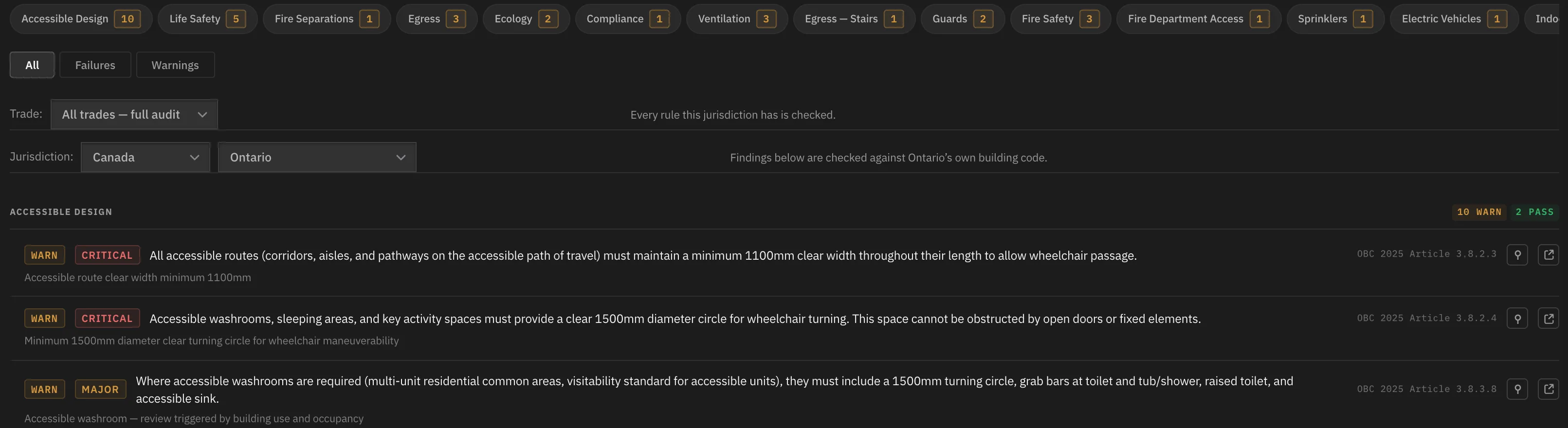
Upload the ugly one. The job with four revisions, an addendum issued three days before close that half the trades never read, a mechanical set drawn by somebody who has never met the architect, and thirty pages that came back from the printer as flat scans. That is the set where a takeoff actually costs you a day, and it is the only set that tells you whether this is worth paying for.
Scanned and photographed pages are fine — they go through OCR before they are read. A phone photo of a marked-up sheet counts as a document.
Days 1–4: run a job you already know the answer to
Start with a project you have already bid and already built. You know what the quantities were. You know which two trades argued about the soffit framing and how much it cost when nobody had priced it.
Run it through Blueprint Auditor and compare. You are not looking for a perfect match — you are calibrating. Three things to write down:
- Where it matched. Which quantities came back within a few percent of what you actually carried.
- Where it drifted, and in which direction. Consistent drift is useful information; you can correct for it. Random drift is not.
- What it caught that you missed the first time. This is the one that decides the purchase, and on a real set there is usually at least one.
Do the same in AI Estimator: price the quantities and compare the total to what you actually submitted. The gap between the two is the most honest number the trial will produce.
Days 5–9: run something live
Now take a set you are working on this week, before you have finished measuring it by hand. Run it, then keep measuring the traditional way and see which one you finish trusting.
The realistic outcome is not that you throw away your method. It is that the program does the volume — the sheets, the counts, the repetitive assemblies, and you spend your remaining time on the four or five items where judgment actually changes the number. If that is what happens, that is the product working as intended.
Days 10–12: export the file and open it
This is the step most people skip and the one that decides whether the tool survives contact with your office. There are no connectors — every handoff is a file you export and import yourself, so find out now whether the file lands.
- Export the Excel report from Blueprint Auditor and give it to whoever normally builds your takeoff sheet. Ask them if they can work from it.
- Export the estimate as a Procore budget CSV, a Sage job cost CSV or a QuickBooks estimate CSV, whichever your office runs, and do a test import into a throwaway project.
- Export the Bluebeam quantity summary and check that the source references let you trace a line back to the sheet it came from.
If a column is wrong for your setup, tell us during the trial. Adding or reshaping an export format is small work and it ships to everyone on the plan. The full list of what each program writes is here.
Days 13–14: decide on one specific question
Not "was it impressive." The question is narrower: on the kind of work I actually bid, does this save me more than $149 a month is worth?
Field is $149 a month, or $1,490 a year, which is ten months for twelve. One recovered afternoon covers the month. One scope gap caught before buyout covers the year several times over. If the fourteen days produced neither, the honest answer is no, and cancelling takes one click.
The three things the trial will not tell you
Worth saying plainly, because a trial oversells itself if nobody draws the line.
- Whether it holds up across document types you did not upload. Fourteen days of residential wood-frame tells you about residential wood-frame. If you also bid ICI fit-outs, run one of each.
- Whether your team will use it. One seat for fourteen days is you, not your office. Adoption is a different question from accuracy, and it is usually the harder one. Pro is where that gets tested, with five seats.
- Long-run accuracy. Two good sets are two good sets. Real confidence comes from a quarter of them, which is why cancelling stays easy well past the trial — any month, from your own dashboard, no reason required.
If it fails on your set, tell us which sheet
Sometimes it will. A title block in a layout nothing has seen before, a scanned sheet too degraded to OCR, a schedule laid out sideways. The useful thing you can do is send us the document that broke it and the page number.
We would rather have a failing document than a polite cancellation. It is the fastest route to the program handling that case, and if it is a category we cannot read at all, we will tell you that instead of taking the subscription.
Fourteen days, your ugliest set.
Unlimited use, every jurisdiction's data packs, nothing charged until day 15. Cancel in one click and you are never billed.
Start Free 14-Day Trial →